Unused public properties: regeneration opportunities near Turin
by Marco Balistreri · · 5 minute read
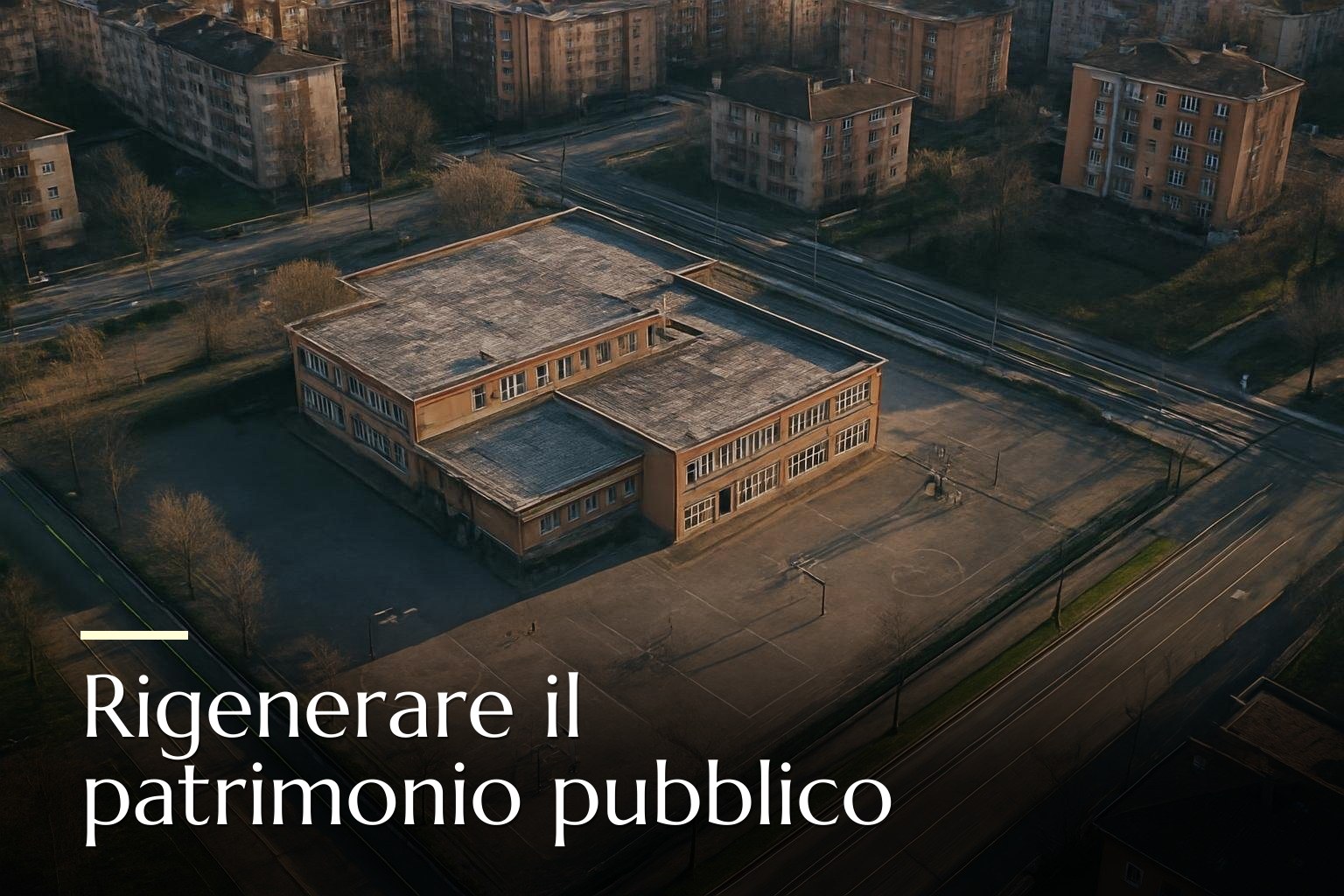
In Turin and its metropolitan area there is a stock of unused public properties that can become real opportunities for those seeking homes, commercial spaces or investments: closed schools, empty offices, warehouses and sports facilities often underutilised can turn into affordable housing, start-up hubs or community service centres through targeted regeneration.
In brief
- Many public units are small: over 76% under 100 m², favouring modular projects and SMEs.
- Municipalities hold most of the assets: regeneration is planned locally.
- Public-private partnerships (PPP), tenders and calls are the main tools to transform unused public properties into viable projects.
- Concrete opportunities for investors: conversion into residences, coworking, shops and services, where local demand and economic sustainability exist.
Why unused public properties matter for investors and home seekers
Unused public properties are a promising starting point for various stakeholders: investors seeking medium-term returns, local construction companies, housing cooperatives, and families looking for affordable housing. In Turin, where demand for homes and commercial space remains strong in many areas, recovering a public building can mean upgrading whole blocks and creating not only real estate but also social value.
Types of properties and possible uses
Unused public properties are varied: houses, offices, schools, warehouses and sports facilities. Each type requires a different approach. In Turin, a closed school can become student housing or a multi-purpose centre; an empty office, with change of use, can become coworking or compact apartments. Warehouses in industrial zones can be transformed into artisan workshops or showrooms for local e-commerce.
Practical tools for those interested in regeneration projects
To transform unused public properties, clear procedures are needed: public calls with proportionate criteria, realistic financial assessments, and an updated database to identify available assets. Investors must consider zoning restrictions, renovation costs, energy certifications and possible incentives (e.g. renovation bonuses for energy improvements). Locally, dialogue with the Municipality is advised to verify priorities and tailor offers to community needs.
Role of local businesses and SMEs
In Turin and Piedmont, micro and small enterprises can play a leading role: many units are under 100 m², suitable for contained interventions not requiring large contractors. SMEs can propose not only construction work, but also post-intervention management, maintenance and energy efficiency improvements. Essentially, a well-calibrated project can be divided into lots to encourage local business participation.
Public-private partnership: opportunities and challenges
PPP is a useful tool to share risks and investments between the public body and private operator. However, an empty property alone is not enough to start a project: real demand, credible financial planning and clauses protecting the public interest are required. In successful cases, the Municipality can tender the property with clear conditions (concession duration, intervention standards, social return), while the operator provides design, capital and management capacity.
Assessing feasibility: quick checklist for investors
- Verify ownership and zoning restrictions with the relevant Municipality.
- Estimate renovation and energy efficiency costs needed.
- Analyse local demand (residential, commercial or services) and the economic plan.
- Consider incentives and financial tools available, including PPP models and business consortia.
- Plan post-intervention management to ensure sustainability and maintenance.
Concrete examples feasible near Turin
In a Municipality in the Turin hinterland, a complex of unused public housing can be redeveloped for social housing managed by a cooperative; in a central district, a former office building can host micro-apartments for young couples or professionals; in a peripheral area, a disused sports facility can accommodate a multi-purpose centre with services for the elderly and small shops. Each project works if tailored to the real needs of the community.
Risk management and sustainability
Investors must consider technical, legal and market risks. A thorough preliminary analysis and contracts that fairly allocate risks are essential. Economic sustainability also relies on energy efficiency: reducing consumption increases property appeal and can make the medium-term financial plan viable.
Useful links
For projects including energy renovations, it is advisable to consider available incentive schemes and assess how to increase the property's value after the intervention: a useful practical guide is Renovation bonus extended to 2027. If the project involves commercial spaces or outdoor areas, it is helpful to know the local regulations: see Outdoor regulation in Turin.
Frequently asked questions
How can I find out which unused public properties are available near Turin?
Contact the heritage or urban planning office of the relevant Municipality: many authorities update lists and tenders; there are also public databases with property censuses. Asking directly at the Municipality allows you to understand local restrictions, conditions and priorities.
Is it better to participate in municipal tenders or propose a partnership project?
It depends on the complexity of the intervention: for small or medium projects, standard tenders may be suitable; for more complex interventions, public-private partnerships allow shared investments and expertise, but require a solid economic plan and clear agreements on responsibilities.
What expenses should I consider besides renovation works?
Besides the works, there are costs for urban planning procedures, system upgrades, energy certifications, municipal charges and legal fees. It is prudent to allocate a 10-20% reserve for technical issues or administrative delays.
Can local companies participate even if they are small?
Yes: many units are small and tenders may include lots and requirements proportional to size. Furthermore, business networks and consortia facilitate SME participation in larger projects.
Practical advice: before committing to an unused public property, request cadastral and urban planning documents, assess local demand and prepare a detailed financial plan including future maintenance. If you want an opinion on a specific property or help interpreting a municipal tender, contact us: we can assist you in understanding feasibility and next steps.
Do you have questions about this topic or your property?
Talk to us