Thermal bridge: new definition of the Minimum Requirements Decree and its impact on renovations
by Marco Balistreri · · 5 minute read
From 3 June 2026 the minimum requirements regulation updated the definition of thermal bridge: no longer just an “interruption of insulation” but a zone of the building envelope where heat loss occurs due to construction discontinuities, geometry or materials with differing conductivity. This change has immediate practical consequences for those selling, buying or renovating homes in Turin: junction design, building permit checks and on-site choices must be reconsidered to avoid comfort issues and value loss.
In brief
- The new definition of thermal bridge has been effective since 3 June 2026 and references the UNI EN ISO 10211 standard.
- A thermal bridge is not always a visible break in insulation: it can result from material differences and junction geometries.
- Practical impact: more thorough checks on junctions, attention to internal surface temperatures and presence of condensation/mould.
- For renovation projects in Turin, it is advisable to integrate envelope design with thermographic surveys and detailed thermal calculations.
What changes in the definition of thermal bridge and why it matters
The new wording of the Minimum Requirements Decree replaces the old definition linked solely to insulation discontinuity at structural junctions. In Turin, as elsewhere, the thermal bridge must be understood as a physical phenomenon related to heat flow: when isotherms deform and heat flow becomes two- or three-dimensional, the phenomenon occurs regardless of visible insulation breaks.
Thermal bridge: practical effects on comfort, healthiness and energy consumption
A thermal bridge can lower the internal surface temperature of walls, corners or window sills, causing surface condensation and mould growth – issues commonly experienced in Turin apartments with windows facing courtyards or cold sides of the city. Also, disruption of heat flow can increase energy losses: it is not just about calculating U-values but ensuring internal surfaces stay warm enough to prevent hygienic and health risks.
Implications for renovators: designing junctions, not just layering
For renovators in Turin today it is essential to treat construction junctions (wall-to-floor, balconies, box frames, window sills) as components requiring careful design. Choosing a thicker insulating material is not enough: the interaction between materials of different conductivity, continuity of the thermal bridge and geometry of the junction must be assessed. Often, calculations with two- or three-dimensional models (according to UNI EN ISO 10211) are needed to verify condensation risk and actual energy impact.
Regulatory checks required and how they apply in practice
The new definition calls for analysis methods involving detailed junction calculations and recognised standards. In practice, for energy requalification or Energy Performance Certificates (EPC) in Turin, designers should detail junctions, assess internal surface temperatures, estimate thermal bridge contribution to losses and, when needed, produce drawings and calculations demonstrating mitigation (e.g., corrected thermal bridges or local/external insulation interventions).
Practical interventions on site: common solutions and critical issues
Effective solutions include well-designed external wall insulation with detailed junctions, local insulation on box frames and sills, using low-conductivity materials at critical points, and careful structural junction treatment during works. In Turin, balconies and wall-to-floor joints commonly cause problems: thermal breaks or dedicated foam and panels can significantly reduce condensation risk. Note: hasty measures that increase overall thermal resistance without correcting junction geometry may still leave cold surfaces and mould issues.
Thermal bridge and property value: why buyers and sellers need to know
A well-designed property from the perspective of thermal bridges offers better energy performance and reduced risks of internal degradation; this impacts market value. In Turin, where efficiency is increasingly demanded, documentation proving checks on junctions and real improvements can facilitate the sale or justify a higher price. At the same time, buyers should request checks on junctions and, if planning renovations, consider a technical framework that accounts for the new regulations.
Costs and incentives: how to plan the intervention
The cost to mitigate thermal bridges varies greatly depending on the intervention: from local insulation of a box casing (a relatively economical measure) to more structural works such as external insulation or replacement of bridging elements (more costly). Regarding incentives, the renovation and energy efficiency benefits active in 2026 may cover part of the work; for condominium works, it is worth evaluating the measures planned for façade and building envelope upgrades (see condominium incentives summary 2026). The Renovation Bonus can also be useful for small targeted interventions (see renovation bonus guide).
Frequently asked questions
What exactly is a thermal bridge according to the new standard?
A thermal bridge is an area of the building envelope characterised by heat loss due to constructional, structural or geometrical discontinuities or the use of materials with different conductivities, in accordance with UNI EN ISO 10211. It is no longer defined solely as a break in the insulation.
Do I need to redo all my junctions if I renovate in Turin?
Not always: this needs to be assessed case by case. For critical junctions (balconies, window sills, box casings, structural joints) a precise calculation or thermographic survey is advisable to decide the most effective intervention.
How do I recognise a thermal bridge that causes mould problems?
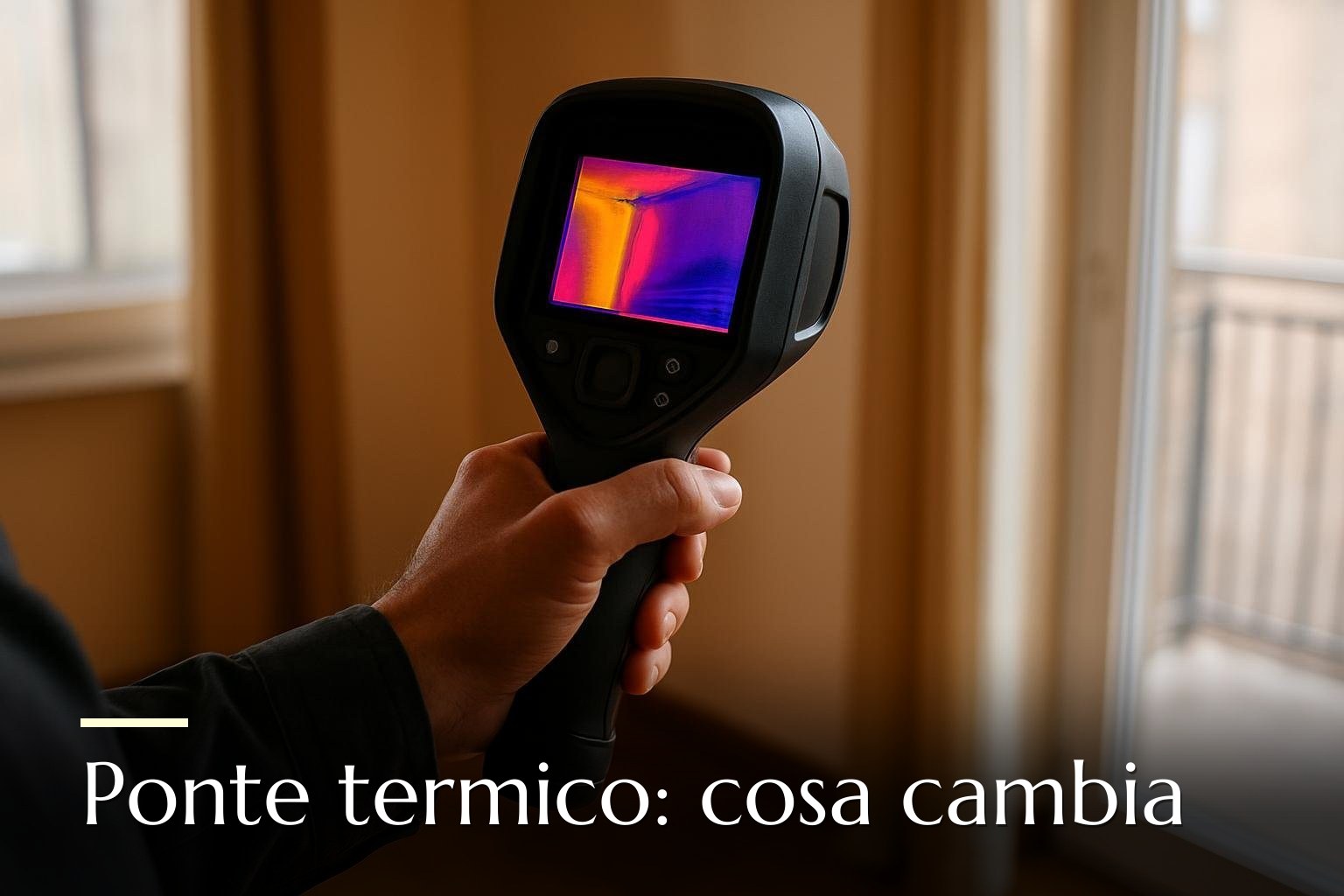
Signs are cold spots on internal surfaces, condensation marks or mould in corners and under window sills. A thermographic survey or surface temperature check can confirm the presence of a thermal bridge.
What documentation is needed to sell or renovate according to the new decree?
For renovations, it is advisable to have a technical report including calculations on junctions and, if required, an updated energy performance certificate (APE). For sales, any demonstrable intervention that improves performance and comfort is an added value.
Practical advice: before intervening, have a precise diagnosis of the junction carried out (thermography and calculation according to UNI EN ISO 10211), prefer solutions that correct the junction geometry as well as improving the layering, and evaluate available incentives to optimise costs and return on investment. If you want a technical opinion on a property in Turin or assistance in guiding a renovation towards effective solutions compatible with the regulations, contact us for dedicated consulting.
Do you have questions about this topic or your property?
Talk to us