
Student housing and social housing: 7 RICS proposals to accelerate affordable housing
by Marco Balistreri · · 5 minute read
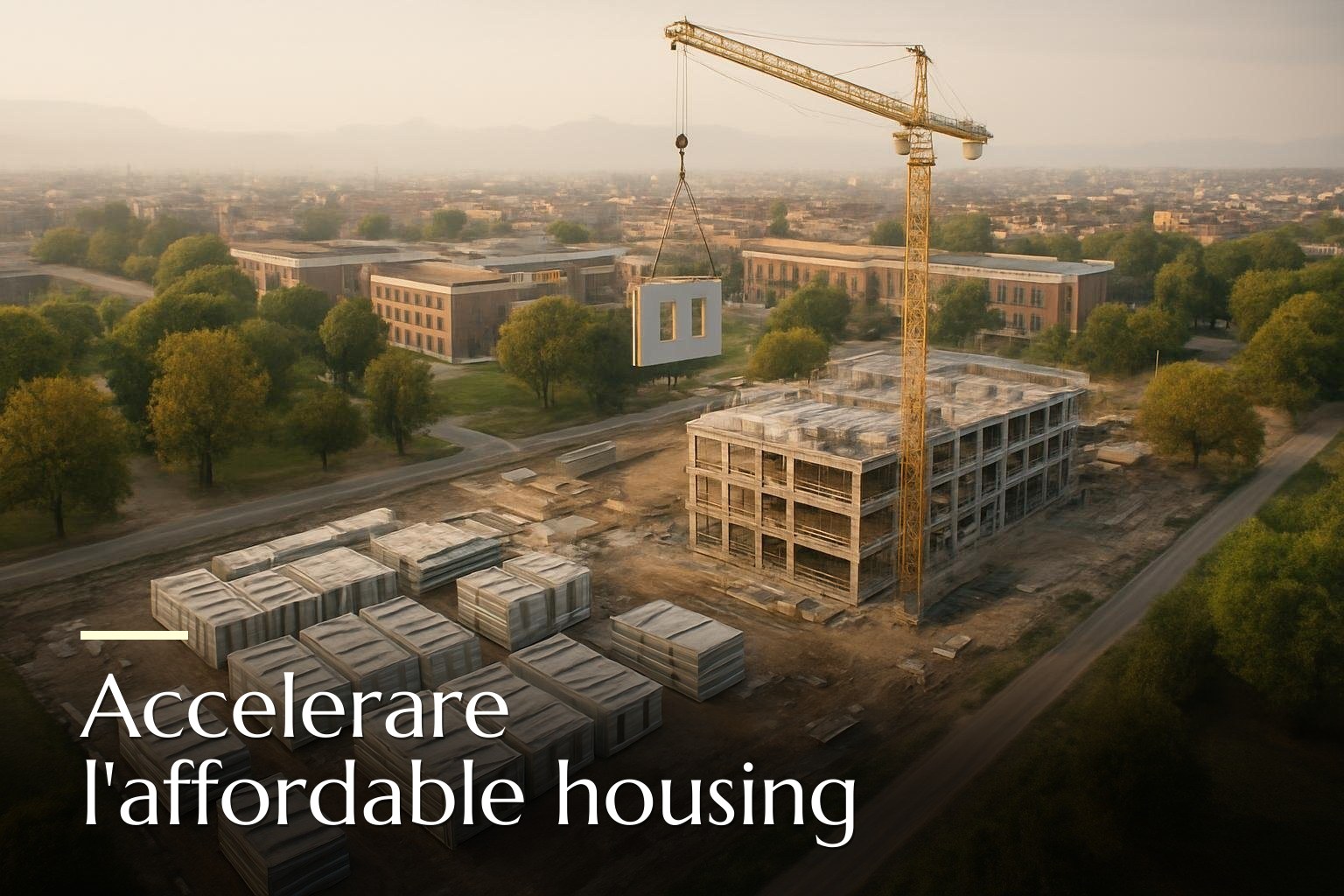
The position paper promoted by RICS in Italy proposes seven concrete actions to accelerate affordable housing, focusing on student accommodation, social housing and collective residences. The core idea is that construction industrialisation (off-site) combined with aggregate demand programmes, regulatory incentives and training can reduce construction times, costs and risks for investors and public administrations.
In brief
- The estimated European demand exceeds 2 million homes per year; in Italy the estimate is between 100,000 and 150,000 units.
- The RICS position paper outlines 7 proposals: five-year planning, incentives for on-time delivery, LCA calculation and digital building logbook, recognition of industrialisation, planning incentives, supply chain rating and training.
- Off-site reduces site impact, increases quality and traceability; the National Recovery and Resilience Plan (PNRR) has already activated over 63,200 student beds in Italy.
- For Turin and local investors, off-site solutions offer opportunities on disused sites, regeneration projects and public-private partnerships.
Why the 7 RICS proposals address affordable housing
The seven proposals identified by RICS address the main barriers to supply: lack of planning, risks of timing and costs, environmental regulatory constraints and skills gaps. In Turin and major Italian cities, demographic pressure and demand for housing for students and young professionals make it urgent to find replicable and low-risk solutions.
The seven proposals: what they entail and why they matter
- Five-year aggregate demand planningDefines student accommodation, social housing and elderly residences demand in advance to enable operators to plan off-site production facilities and optimise supply volumes.
- Incentives for those who meet deadlinesEconomic or contractual incentives for those who complete construction on time reduce risk of delays and increase investor confidence.
- LCA calculation and digital logbookIncluding life cycle emission calculations and a digital logbook for public buildings from the start helps plan maintenance interventions and monitor energy performance.
- Recognising construction industrialisation as a strategic supply chainGiving priority to off-site in industrial policies encourages investment in production plants and local value chains.
- Planning incentives for convertible buildingsFacilitating change of use and offering planning benefits for buildings designed for the future increases housing supply flexibility.
- Supply chain rating for operatorsA rating system rewards structured companies and provides growth paths for SMEs, improving reliability and access to credit.
- Specific training for public and private sectorsNew professional roles and skills in off-site construction and energy efficiency are needed to design, procure and manage interventions.
Off-site: tangible benefits for projects in Turin
In Turin, off-site is particularly interesting for regeneration projects of former industrial areas or university campuses: factory production allows reducing onsite construction times, minimising neighbourhood disruption and improving build quality. For investors, this means lower risk on timing/costs and greater yield predictability.
How private investors can leverage these proposals
Investors need to assess the supply chain: prefer companies with industrialised processes, request certifications and performance data, and negotiate contractual clauses rewarding on-time completion. Considering off-site components can be advantageous especially in long-term strategies, such as student housing or social housing for stable rentals.
Role of public administrations and useful tools
Local administrations can accelerate affordable housing by offering public land on concession, defining calls rewarding industrialisation and including LCA requirements in specifications. A practical example is calls that demand certain deadlines and provide planning incentives for easily convertible buildings.
Risks and critical issues to consider
Off-site requires initial investments in plants and logistics; moreover, the Italian supply chain is fragmented and needs a qualification path for SMEs. Environmental efficiency and performance regulations may also increase costs if not accompanied by incentives and coherent planning.
Practical implications for those designing student accommodation and social housing
For projects in Turin and Piedmont it is useful to start with: 1) analysis of local demand (university students, young professionals), 2) identification of disused sites or parking areas for redevelopment, 3) selection of industrial partners for off-site components, 4) definition of LCA and contractual indicators for timing and quality. Planning maintenance with a digital logbook helps to keep units available over time.
Frequently asked questions
What is off-site construction and how does it differ from traditional prefabrication?
Off-site construction is the factory production of elements and panels with standardised interfaces and traceable processes; compared to traditional prefabrication, it offers greater design flexibility, quality control and reduced site impacts.
Do RICS proposals require regulatory changes?
Some measures can be adopted without legislative changes, such as tenders with incentives and five-year programmes; others, like integrating LCA calculation into directive transpositions, require regulatory interventions or ministerial guidelines.
How much can off-site methods reduce timelines?
The reduction depends on scale and organisation: in projects attentive to logistics, off-site can significantly shorten on-site activities, limiting construction to assemblies lasting weeks rather than months or years.
How to assess a partner for student housing projects in Turin?
Check past experience, production capacity, LCA calculation skills, references on delivery times and contractual guarantees; prefer entities with supply chain ratings or certified growth plans.
Practical advice: for investors or designers in Turin, initiate a local demand survey as early as possible, consider public regeneration sites, request proposals including timing and performance indicators, and include incentive clauses in contracts. If you want an opinion on a specific project or a student demand assessment in Turin, contact us: we can help evaluate feasibility, costs and operational partners.
Do you have questions about this topic or your property?
Talk to us